Options for Beginners: The Exact Sequence I'd Follow Starting From Scratch
If I had to start over with options trading today, knowing what I know after years of doing this professionally, I wouldn't change the destination. I'd change the order I learned everything in. Because the biggest problem with learning options isn't a lack of information. It's too much information hitting you in the wrong sequence.
Most beginners jump straight to buying calls and puts without building a foundation, blow through their first account, and then either quit or circle back to the basics they skipped. I've watched it happen hundreds of times in our NavigationTrading community. The traders who succeed aren't smarter than the ones who fail. They just learned things in the right order.
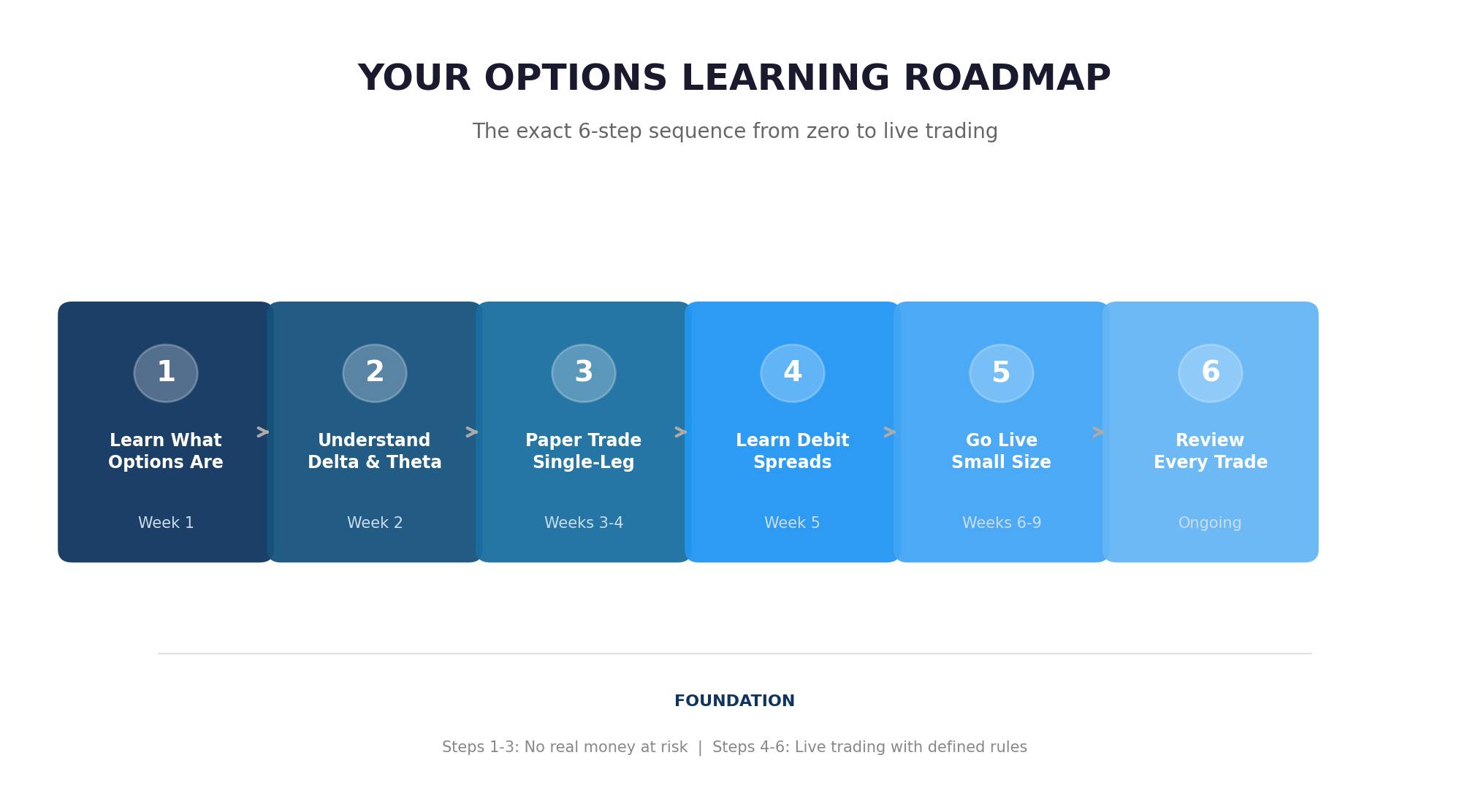
So here's the exact sequence I'd follow if I were starting from zero. No shortcuts, no skipping steps. This is the path that would've saved me years of frustration and thousands of dollars in tuition paid to the market.
Step 1: Learn What Options Actually Are (Before You Touch a Single Trade)
Before you click a single button in a brokerage account, you need to understand what an option contract actually represents. An option gives you the right, but not the obligation, to buy or sell the underlying instrument at a specific price by a specific date. That's it. Calls give you the right to buy. Puts give you the right to sell.
Spend a full week here. Understand what strike price means, what expiration date means, what the difference between intrinsic and extrinsic value is. Learn what "in the money," "at the money," and "out of the money" mean until you can explain them without looking anything up. This is the foundation. If you skip it or rush through it, every single thing after this will be confusing.
I know this sounds basic. It is basic. But I can't tell you how many traders rush into trading options and can't even explain the difference between a call and a put. That's like driving on the highway without knowing what the brake pedal does.
Step 2: Understand the Main Greeks (But Only the Ones That Matter Right Now)
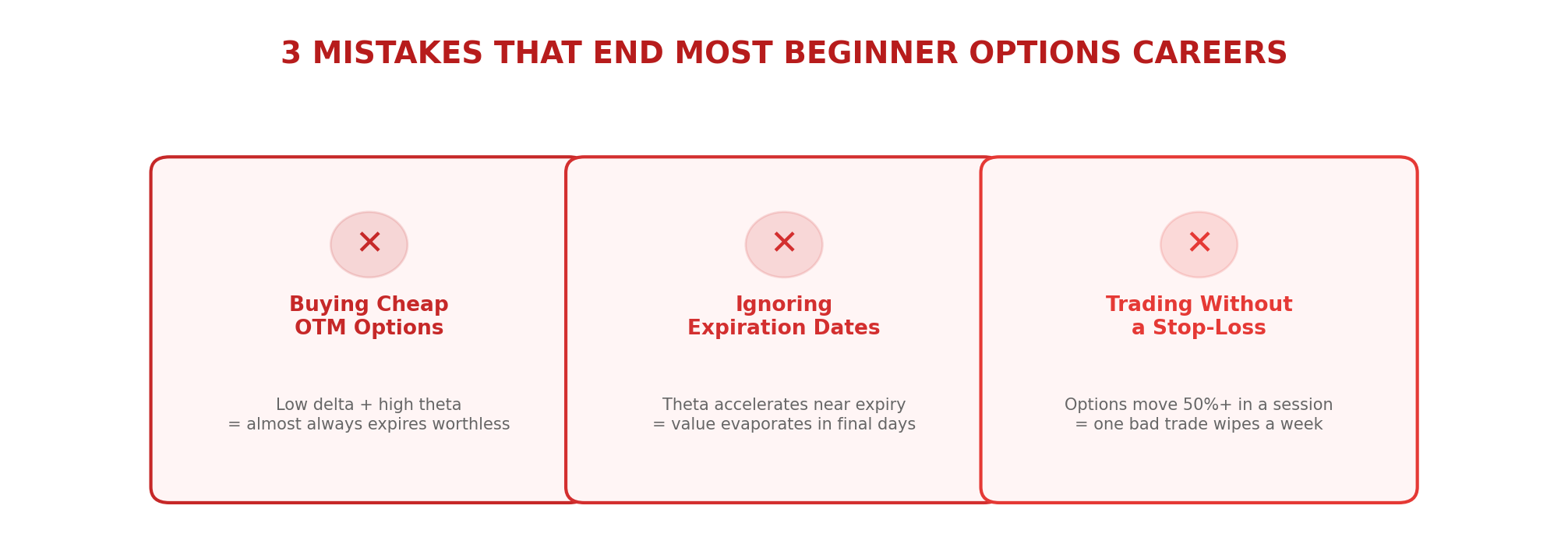
The options Greeks are the variables that affect an option's price. There are five main Greeks, but as a beginner, you only need to deeply understand two: Delta and Theta.
Delta tells you how much the option price moves for every dollar move in the underlying stock. A 0.50 delta call will gain roughly $0.50 for every $1.00 the stock moves up. This is the single most important number for directional trading. When we say "buy a 40 delta call" at Navigation Trading, this is what we're talking about.
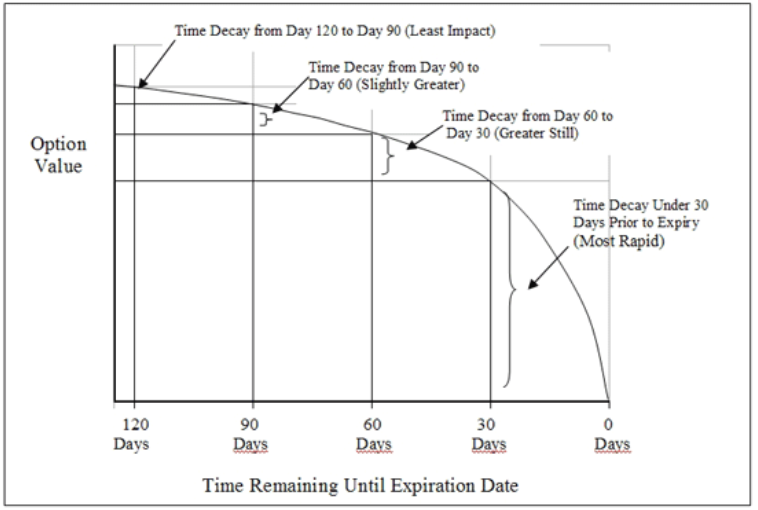
Theta tells you how much value the option loses each day just from time passing. This is why options are a decaying asset. Every day you hold an option, it loses a little value even if the stock doesn't move. Understanding theta is what separates beginners who constantly lose money from traders who manage their positions properly.
Gamma, Vega, and Rho matter too, but save those for later. Trying to learn all the Greeks at once is how beginners get overwhelmed and quit. Delta and theta first. You can layer in the rest after you've got a solid foundation.
Step 3: Paper Trade for at Least One Month
Now you know what options are and how delta and theta work. Time to place trades. But not with real money. Not yet.
Open a paper trading account with your broker. Most platforms offer this for free. Your only goal for the first month is to practice the mechanics: finding the options chain, selecting a strike, choosing an expiration, entering a market or limit order, and closing the position. Don't worry about being profitable. Focus on being comfortable with the process.
Buy calls when you think the stock is going up. Buy puts when you think it's going down. Watch how delta and theta affect your position in real time. Notice how a stock can move in your direction and your option still loses money because theta ate into the premium. That lesson is worth more when it costs you nothing.
One month minimum. If you're still fumbling with order entry after one month, keep going until it feels automatic. The last thing you want when real money is on the line is to second-guess which button to press.
Step 4: Learn One Spread Strategy (Start With Debit Spreads)
Once you're comfortable buying straight calls and puts, the next step is learning your first spread. I'd start with the vertical debit spread. Here's why: it caps your risk, it reduces the impact of theta decay, and it costs less than buying a straight option.
A call debit spread means you buy a call at one strike and sell a call at a higher strike. Your max profit is the difference between the strikes minus the debit you paid. Your max loss is the debit. That's the entire risk profile. No surprises, no margin calls, no waking up to a negative account balance.
Understand how the width of the spread affects your risk and reward. Practice it in paper trading until you can set one up in under 30 seconds. Once debit spreads feel natural, you can explore credit spreads, iron condors, and calendars down the road.
Step 5: Go Live With Small Size and Strict Rules
You've spent three to four weeks building the foundation. Now it's time to trade with real money, and this is where 90% of beginners blow it. They go from paper trading to full-size overnight. Don't do that.
Start with the smallest position size your broker allows. One contract. One single debit spread. Your goal for the first month of live trading is not to make money. It's to follow your rules and manage your emotions. Real money feels different than paper money.
The first time a live trade goes against you by $100, your brain is going to scream at you to do something irrational. That's normal. The traders who survive the first month are the ones who stick to their plan anyway.
Set three rules before your first live trade: a maximum dollar amount you're willing to lose per day, a maximum number of trades per day, and a stop-loss level for every position. If any of those rules get hit, you're done for the day. Close the platform and walk away. You can trade again tomorrow.
Step 6: Review Every Single Trade You Take
This is the step that separates traders who improve from traders who repeat the same mistakes for years. After every trading session, review your trades. Not just the losers. Every trade.
Write down what the setup was, why you entered, where your stop was, what happened, and whether you followed your rules. You don't need a fancy journal. A spreadsheet works. A notebook works. The format doesn't matter. What matters is that you're being honest with yourself about what you did right and what you did wrong.
Over time, patterns emerge. You'll notice that you lose money when you trade in the first 5 minutes of the market open. Or that your best trades happen between 10 and 11 AM. Or that you overtrade on red days because you're trying to make back losses. These insights only come from reviewing your trades, and they're worth more than any indicator or course.
The Three Mistakes That End Most Beginner Options Careers
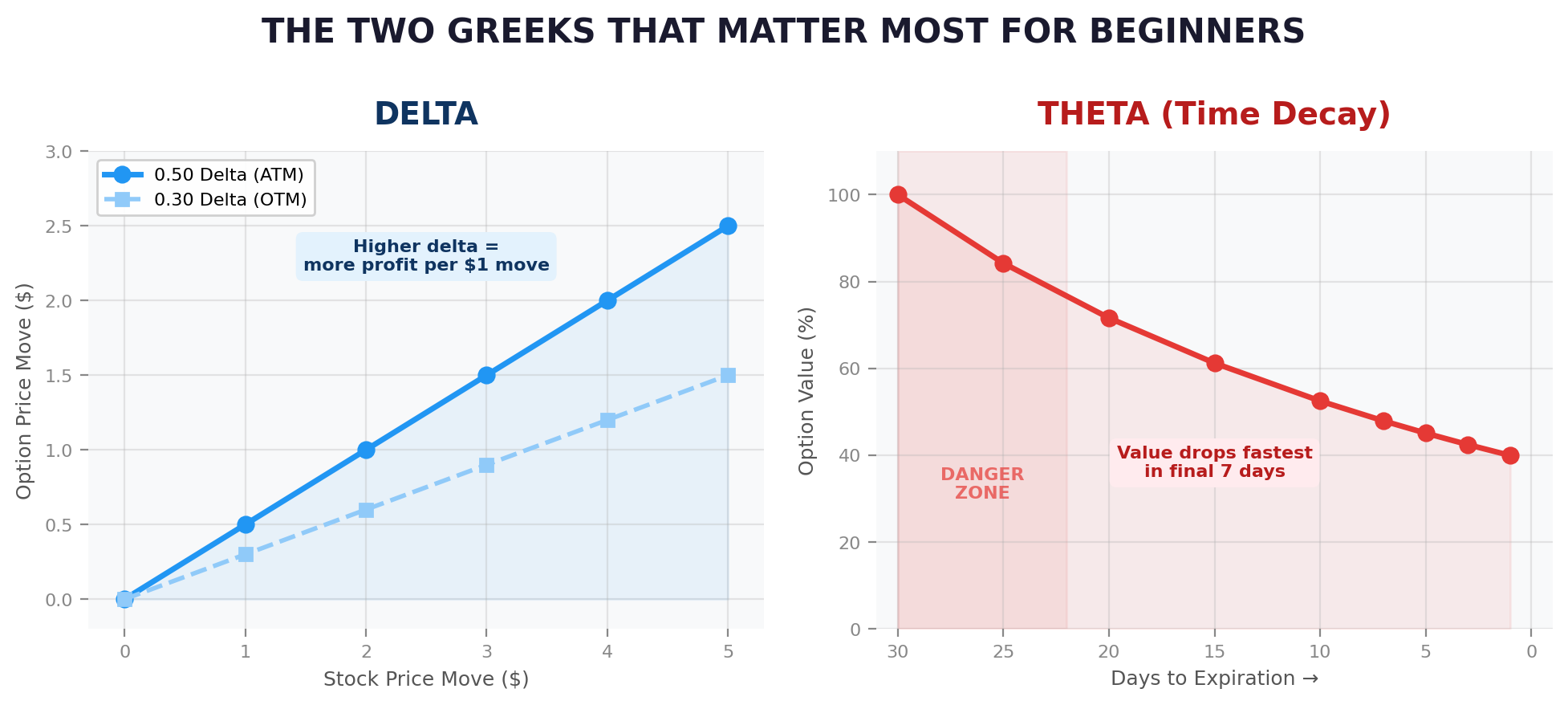
Buying cheap out-of-the-money options. They cost less, so beginners load up on them. The problem is they have low delta and high theta. The stock has to move a lot, fast, for these to be profitable. Most of the time, they expire worthless. Stick to 35-50 delta options until you know why you'd deviate from that range.
Ignoring expiration dates. Beginners buy options expiring in one or two days without understanding how aggressively theta accelerates near expiration. Every day that passes, your option loses more value than the day before.
Trading without a stop-loss. Options can move 50% or more in a single session. If you don't have a plan for when to exit a losing trade, one bad position can wipe out a week's worth of gains. Define your exit before you enter. Always.
Stop Guessing the Market.
Start Trading With Math.
Our methodology is built on statistics and probabilities — not hype, emotion, or market gurus. Get your first 5 strategy courses completely free and start building real, consistent results.
Frequently Asked Questions
How much money do I need to start trading options?
You can start with as little as $500 to $2,000 if you're trading debit spreads and small single-leg options. The key is to size your positions so that no single trade risks more than 2-5% of your account. Starting small is more important than starting big.
How long does it take to become profitable with options?
The reality is… we don’t know - and we never will. How long it takes for you to become profitable depends on several factors. Some traders start and become profitable in their first year, and others take 5+ years to find consistency. It all comes down to the amount of work you are willing to put in.
Should I start with calls and puts or go straight to spreads?
Start with single-leg calls and puts in paper trading to understand how options move. Then transition to debit spreads when you go live. Spreads give you defined risk and reduce the impact of time decay, which makes them much more forgiving for beginners.
Do I need to understand technical analysis to trade options?
Yes. Options are directional instruments, which means you need to have a view on where the stock is going. Basic chart reading, support and resistance levels, and trend identification are essential. You don't need to be an expert, but you need to be able to read a chart.
Your First 30 Days Start Now
Here's the sequence one more time: learn what options are, understand delta and theta, paper trade single-leg options for one month, learn debit spreads, go live with small size and strict rules, and review every trade. That's the roadmap. It's not sexy. It's not fast. But it works.
The traders in our community who followed this sequence are the ones still trading a year later. The ones who skipped steps are the ones who blew their accounts and disappeared. The market doesn't care about shortcuts. It rewards preparation.
If you want guidance along the way, our Navigation Trading membership gives you live trading sessions, pre-market levels, and a community of traders who have walked this exact path. You don't have to figure this out alone.
Studies show investors who check their portfolios daily make worse decisions than those who review weekly. A rules-based system eliminates emotion by design — and emotion is what kills most trading accounts.— Behavioral Finance Research & DALBAR Studies
Ready to learn options the right way—on any platform? Join the Navigation Trading free membership and start with our beginner options sequence. No platform lock-in. No gimmicks. Just the concepts that actually make you a better trader.